Since its release on December 25, 2021 (reasonably a Christmas provide!), the James Webb Area Telescope (JWST) has captured the sharpest, maximum detailed pictures of the universe, surpassing even its predecessor, the venerable. Hubble Area Telescope! However what is particularly thrilling are the sorts of observations we will sit up for, as JWST will use its complex functions to take on probably the most cosm’s maximum urgent mysteries. For instance, there’s a drawback led to via excessive redshift supermassive black holes (SMBHs) or brilliant quasars that existed all over the primary billion years of the universe.
Till now, astronomers have no longer been ready to resolve what the SMBHs would possibly were like so quickly after the Large Bang. A part of the issue has been, till not too long ago, that stars in host galaxies have redshift values of Z > 2 (within the order of 10.324 billion gentle years) out of achieve. However due to JWST, a global group of astronomers not too long ago noticed stars in quasars at Z > 6 (inside of 12.716 billion light-years) for the primary time. Their observations may in spite of everything permit astronomers to evaluate the processes in early quasars that ruled the formation and evolution of the primary SMBHs.
The group consisted of astronomers from more than one institutes, universities and observatories in Japan, China, Europe, the UK, america, Brazil, Taiwan and Israel. Notable establishments come with the Kavli Institutes, the Max Planck Institutes, the Institute of Astrophysics in Paris (IAP), and observatories such because the Nationwide Astronomical Observatory of Japan (NAOJ), WM Keck Observatory, Steward Observatory, Leiden Observatory, and others. Their learn about, “First Detections of Starlight from Quasar Host Galaxies at z>6,” is being reviewed for newsletter within the magazine nature.

Take away all advertisements at the universe nowadays
Sign up for Patreon for best $3!
Get an ad-free revel in for existence
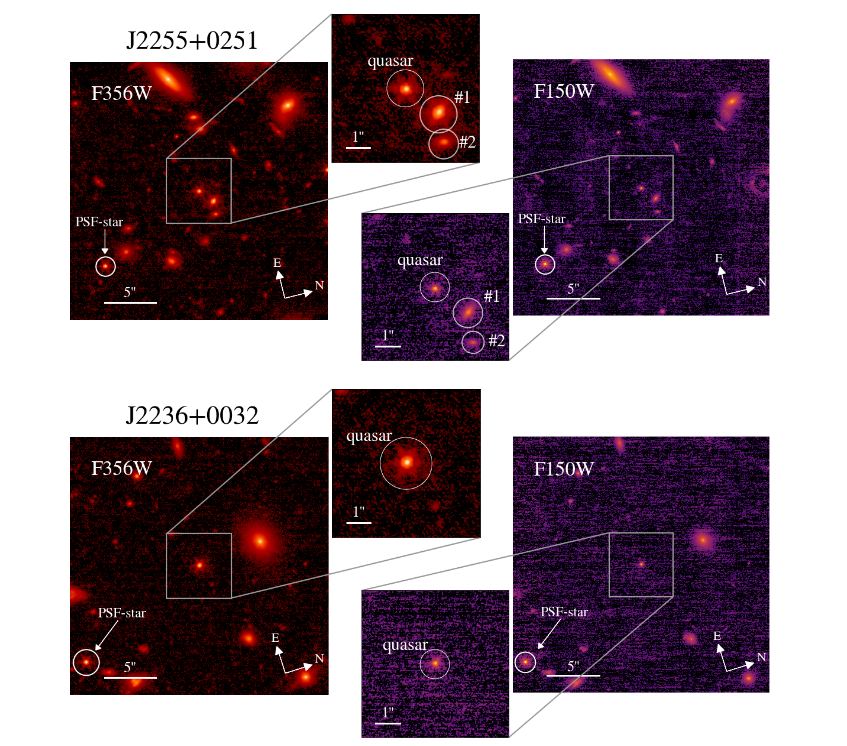
Previous to JWST, observations of excessive redshift galaxies had been restricted via knowledge high quality and may no longer give you the important high quality level scatter serve as (PSF). This describes the power of an optical device to obtain extremely targeted, high-resolution pictures of a far off gentle supply. To shed some gentle at the new observations, Universe These days spoke with venture lead and lead creator Xuheng Ding (Kavli PMU) and co-authors Masafusa Onoue (Kavli PMU/Max Planck Institute for Astronomy) and John D. Silverman (Kavli PMU/College of Tokyo). In addition they related up by the use of electronic mail:
Necessarily, to locate a quasar’s host galaxy, quasar + host symbol decomposition will have to be carried out. A quasar is an unresolved level supply that may be described via a PSF scale. This PSF data is typically from remoted stars within the box of view.
“But even so, the JWST has upper decision knowledge and will track a redder wavelength than the HST to permit for this learn about with a better redshift pattern. Every other good thing about this program is that we’ve got proposed staring at much less luminous quasars, which makes subtracting pictures of quasars more straightforward.”
The quasars they selected for his or her analysis had been J2255+0251 and J2236+0032, which might be somewhat low-brightness quasars at redshifts of 6.34 and six.40. This corresponds to a distance of about 13.43657 and 13.5637 billion light-years (when the sunshine we see left those gadgets), or 24.876 and 25.11 billion light-years nowadays. Those quasars had been first recognized as a part of a survey referred to as the Subaru Prime-z Exploration of Low Luminos Quasars (SHELLQs). This survey used the Subaru Telescope’s HSC software to look at 162 low-brightness quasars that existed a thousand million years after the Large Bang.
Those quasars at the moment are the topic of follow-up observations via the JWST program to check excessive redshift galaxies and apply stars of their disks for the primary time. For his or her learn about, the group tested knowledge bought via JWST’s Close to Infrared Digital camera (NIRCam), adopted via modeling and subtracting the glow of the quasars themselves. They then when put next their observations with research of simulated quasar hosts at a excessive redshift. The group spotted some fascinating options about those quasars and their SMBHs that set them excluding different early galaxies.
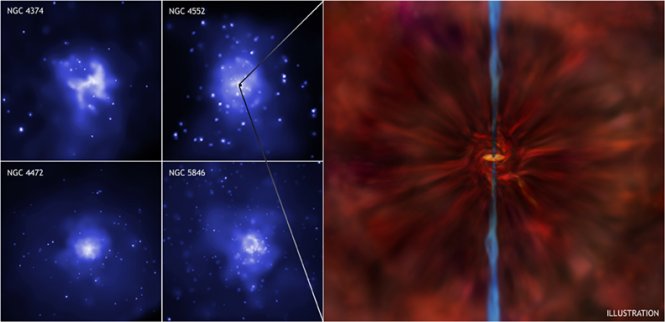
“The effects display that the host galaxies of those two quasars are large and compact,” Ding and co-workers stated. “The central positions of the quasars are offset, most likely because of asymmetric mud attenuation or it will point out that this SMBH isn’t on the heart of gravity chance really well but.”
That is very similar to contemporary observations of Z>6 quasar host galaxies that had been in keeping with the Atacama Massive Millimeter Array (ALMA). Those observations additionally famous displacements in early quasars between the central SMBHs and the encompassing interstellar fuel, mud, and stars. The group additionally notes that those offsets may well be because of asymmetries created via tidal forces, most likely because of galaxy interactions or clumps gathering chilly fuel. The group will check those hypotheses in additional papers in keeping with knowledge from JWST’s Close to Infrared Spectrometer (NIRSpec) for 12 early quasars. As Ding and co-workers put it:
“The significance of this primary paper highlights the giant energy of the JWST and demonstrates the potential of detecting a quasar host at z > 6. In the long run, our program will identify the primary z~6 quasar measurements of the host big name’s mass and SMBH mass dating, which might be used to grasp the co-evolution of the galaxy and its central SMBH. Those works can also be helpful in working out the foundation of the SMBH within the early universe.”
Additional studying: arXiv