Diagram of the use of multiple cameras in the Goal Control goal-line technology system. Below is all you need to know about goal-line technology in Football (GLT).
History
In July 2012, International Football Association Board (IFAB) officially introduce the use of goal-line technology, to amend and correct errors that might be caused in the field of play, especially at the point of the goal. Before the introduction of GLT, there are lots of goals to be considered a goal or not as a goal.
Goal-line technology in football is sometimes referred to as the Goal Decision System. This is an electronic device that helps the referee determine if a goal has been scored or not. In essence, it is used to check if the ball has totally crossed the line drawn in between the goal-posts or the line below the crossbar with the help of an electronic device (Goal-line technology). One of the aims and objectives of Goal-line technology is to help the officials in making an accurate decision but not to replace them (officials). It is the Goal-line technology (in football) that will provide a clear picture indicating whether the ball has crossed the line or not and a signal will be sent to the referee for a quick decision. The referee has to decide in seconds on the pitch.
History Continues
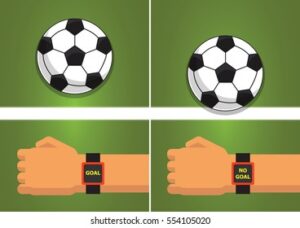
But there are some moments that the referee is not sure and certainly clear if the ball is a goal or not due to a quick save from the goalkeeper, fast clearance from the defender, or the immediate movement of the ball from the line back to the field, in this serious moment that everyone is concentrated on the referee, the decision has to be made as fast as possible. The referee can be communicated through his headpiece or through the wristwatch on the wrist of the referee attached or connected to the Goal-line technology. This wristwatch on the referee will give a signal to the referee whether the ball is a goal or not. Such that the wristwatch will “display Goal” on its surface or “vibrate” if the ball is a goal and will not display anything and not vibrate if not a goal.
Since its introduction in 2012, GLT isn’t used in all levels of matches because of its high cost of expenses. But are only used at a very important game and at the highest level of the competition. Since then Goal-line technology (GLT) has been used in major international tournaments (Men’s and Women’s). Below is all you need to know about the Goal-line technology in Football.
Current implementation
GLT is not used in all leagues and competitions due to the fact that it is very expensive. Goal-line technology is regularly only used in European leagues. Like the Premier League, Laliga, Serie A, Bundesliga, Ligue 1, Champions League, Europa League, and some matches in Eredivisie.
As of January 2020, FIFA’s website lists a total of 109 stadiums with licensed GLT installed. Of which 106 use the “Hawk-Eye” system. While the other three use “Goal Control” which is the other licensed provider.
Hawk-Eye
Hawk-Eye technology is the most technological system used amongst all other varying technologies in determining a goal. It makes use of fourteen sophisticated cameras which are positioned around the stadium at different locations pointing towards the two firm goalposts, seven focused on each.
This technology is not something new, it has been widely used in other sports for the past decade (10 years), most especially in tennis, cricket, and games of snooker. These sophisticated cameras track and find the ball with greater accuracy and use triangulation to calculate the actual position of the ball relative to the goal line.
As the name connotes, the technological system forms a triangle between these three points and uses the angles between them just to determine the location of the third unknown. This then creates a 3D image of the ball relative to the goal line.
This technology (GLT) produces a very reliable result even if some camera views were blocked by players or ball-boy in the course of taking the ball around the pitch. This is simply possible because only three of the fourteen cameras were needed to implement triangulation and generate an image. So, therefore, if few cameras are blocked others can take over without any problem.
Once the ball fully crosses the goal line, a signal will be sent to the referee through the watch or an earpiece just within a second, telling the referee that it is a goal.
Goal Control
The Goal Control technology works exactly like the Hawk-Eye technology. With fourteen cameras fixed around the stadium, seven cameras are dedicated to each goal pole. The ball position is calculated to eliminate any ambiguity regarding the ball crossing the goal line. One demerit of this is that it is very expensive to implement compared to the Hawk Eye. It was dismissed by top leagues due to its higher cost.
Goalminder is another goal-line technology that is not widely known. Cameras are fixed on the inner side of the poles (goal pole), compare to the Hawk Eye and Goal Control which involves fixing cameras around the stadium. One disadvantage of the Goalminder is that it might mistakenly be hatted by a ball or by the goalkeeper. And can stop working since it is fixed in the inner part of the pole.
Examples
Looking at Frank Lampard’s goal that was denied against Germany in the 2010 world cup. Which is an absolute goal if Goal Line Technology has been in practice by then maybe that would have been the turning point for the England national team. Even though the ball crossed the goal line and was very fast in moving back to the field of play, the referee says no goal.
Also in 2021, in a qualifier match between Portugal and Serbia. Cristiano Ronaldo scored in the additional time for Portugal to win the match for Portugal. The score was 2 – 2 before the horrible scene. But the referee declared that no goal, in which the ball had totally crossed the goal line but was cleared out by a defender after crossing the goal line. Unfortunately, there is no goal-line technology installed on the field of play.
The referee is expected to test the Goal Line Technology prior (before) the match begins. And to be abandoned in case of any error or fault detected. The use of approved balls with integrated technology is very essential.
Ex-Manchester City player, Eden Dzeko was the first Premier League player to score a goal cleared by the GLT.
Note
Remember, the ball must fully cross the line for it to be counted as a goal.
Also Read:
- Positive Effect of Video Assistant Referee (VAR) in Football
- Essential things to know about joint pains
- THE BVAS
If you find this article helpful, like and comment.
Thanks for reading.